Understanding The Costs
You might think that spending months running around the wilderness with a bunch of dogs requires little more than a healthy dose of physical stamina and a little bit of crazy. In fact, there is another key ingredient to safe and successful sled dog racing - good ol' cash. Kibble doesn't grow on trees, and neither do dog booties, sleds, the gear required by mushers to face extremely cold temperatures, and the vehicle and fuel needed to drive all of this to the starting line of a race. Competitive events with cash purses require entry fees, and even the mid-distance race entry fees are usually $250 or more. As you have now started to guess, the costs add up very quickly.
But what about the long distance races like Iditarod and Yukon Quest? I think you will be very surprised to learn that the financial wherewithal required to participate in these events is as much of an undertaking as the events themselves.
The following is a detailed account of the approximate costs associated with running the Iditarod. Costs for the Yukon Quest are very similar. These figures are based on the twins' most recent experiences and are best approximations.
Kristy and Anna work very hard during the off season to allow them to cover as many of the costs as possible. But covering the bottom line requires the generous support of sponsors, family, and friends. And for this, Anna and Kristy cannot thank them enough!
Show me da $$$ ~ Per Single Iditarod Entrant
- Iditarod Entry Fee for 2022: $4,000 per musher.
- Travel Costs: $1,500. The Iditarod requires the musher to pay for flying the dogs home from the finish line in Nome, Alaska, along with themselve, at least one handler, and all the gear.
- Pre-race Vet Checks: $350. This covers travel costs to and from the mandatory vet check. The Iditarod also requires a deposit at a vet clinic prior to the race in case a dog dropped during the race needs special care.
- Misc. Expenses the week before and the week after the race: $1,500. There is a LOT to get done immediately before the race that requires being near the race's starting line, so much of this expense is estimated food and lodging costs away from home. At the finish line, the race offers host facilities, but other lodging is available and sometimes necessary. Most meals must be purchased in Nome where the race finishes, a remote town where food is expensive. One commonly overlooked expense is the purchase of sky kennels, which are used to ship the dogs home and usually cost upwards of $75 each.
- Handler Costs: $500. Costs can fluctuate depending on the handler's needs and his or her home base.
- Dog Booties: $1,800. These are estimates based on bootie prices and can vary based on the number of dogs used and how long they are used during the race.
- Dog Food: $2,400. These figures can vary depending on the type of dog food, the amount of time on the trail, and the number of dogs used in each race. The Iditarod does not return unused dog food from the checkpoints, and since they require a 60 pound minimum per drop bag, that can lead to an unfortunate amount of wasted food. Each musher will ship out between 1,200 and 1,800 pounds of dog food, which averaged out to about $1.00 per pound. On top of the food bill is the cost to ship it out, also $1.00 per pound.
- Sled Maintenance Costs: $1,000. This primarily covers cost of plastic for the sled runners (we opt to ship out 8 rolls of plastic each, at U$50 per set) and spare parts, plus the cost of sending our spare sleds to checkpoints later in the race. This does not include the cost of the sleds themselves (should you buy them ready made or buy parts with which to make them, as we typically do).
- Musher Food: $250. This covers the food sent out in the musher's drop bag to refuel themselves when they resupply at each checkpoint.
- Musher's Personal Items: $500. This amount can vary considerably, but this estimate covers many basic drop bag items like socks, batteries for headlamps (and my goodness, do we go through a lot of batteries), toiletries, hand and foot warmers, etc.
- Other Equipment & Gear: $8,000. These estimates include a wide variety of things, like: ganglines, harnesses, the sleds themselves (each musher ideally has two for use during the race, and the twins have built their own sled for approximately $1,800 each) sled bags, mandatory gear required by the race (cooker, ax, sleeping bag, show shoes, etc), snow hooks, ski poles, dog coats, dog leg protectors, vaccines, medications, and supplements, cooler, dog bowls, food dipper, and therapeutic shoulder coats for the dogs. Gear for the musher includes long underwear, jackets, fur hood ruff, Anorak suits, gloves, mittens, neck gators, boots, headlamps, goggles, hats, and more. Many of these items are purchased periodically and not annually.
And the total comes to (drumroll please!)...
$21,800 **
** WHAT ABOUT THE DOGS?! **
** You may have noticed that there are a lot of costs in the above list associated with the dogs, but no line item to account for the cost of the dogs themselves. We opted to address that separately as there are several ways one can secure the use of a dog team. For example, in the past Kristy made arrangements with another musher and kennel owner so that the use of a team for racing was part of her employment. Some mushers will lease an entire dog team and race and train with a kennel. Leasing a dog team can be very costly, often ranging from $15,000 to $20,000 for one season! Still others will purchase or breed all of their own dogs. Anna and Kristy own many Iditarod-worthy dogs of their own and will lease or borrow enough other dogs to fill out their teams. They will also continue to watch for good dogs to purchase or breed as opportunity and funding allows. To properly care for each dog they currently own, the twins budget $2,000 per dog per year to account for food, shelter, vet checks and vaccinations, and other miscellaneous items.
** You may have noticed that there are a lot of costs in the above list associated with the dogs, but no line item to account for the cost of the dogs themselves. We opted to address that separately as there are several ways one can secure the use of a dog team. For example, in the past Kristy made arrangements with another musher and kennel owner so that the use of a team for racing was part of her employment. Some mushers will lease an entire dog team and race and train with a kennel. Leasing a dog team can be very costly, often ranging from $15,000 to $20,000 for one season! Still others will purchase or breed all of their own dogs. Anna and Kristy own many Iditarod-worthy dogs of their own and will lease or borrow enough other dogs to fill out their teams. They will also continue to watch for good dogs to purchase or breed as opportunity and funding allows. To properly care for each dog they currently own, the twins budget $2,000 per dog per year to account for food, shelter, vet checks and vaccinations, and other miscellaneous items.
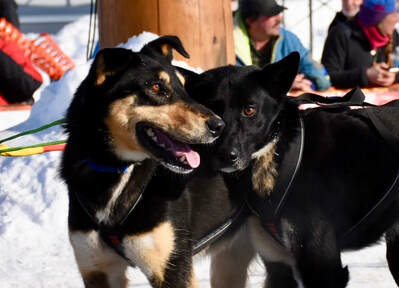
Happy, Healthy Pups from Kristy's Team at the finish line of Iditarod 2019.
|
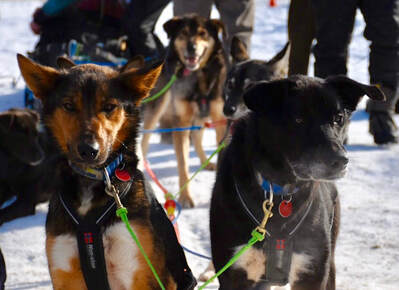
"So... where's my snack? And where to next?!" Dogs from Anna's team at the Iditarod 2019 finish.
|